There’s been some discussion lately on ditching the phrase “Delaware Valley” in favor of some variant of “Greater Philadelphia”. The reason given is that “Delaware Valley” allows (suburban) Philadelphians to dissociate themselves from Philadelphia.
I admire where the sentiment is coming from, but for now, I can’t see the language choice as important enough to police my own language or scold anyone else for theirs. This may change in the future, or it may not. Still, I thought I should make a note for those as do care.
It is 4:45am. The first northbound Norristown High Speed Line (NHSL) train in revenue service is about to cross the Bridgeport viaduct into Norristown, ending a four month closure for critical repair work. NHSL Norristown riders can breathe a sigh of relief, with cumbersome shuttle busing no longer part of their daily routine.
But as one major repair project ends, the prospect of starting others that are just as needed grows dimmer. Not a week has gone by since mid-September, that either House Majority Leader Turzai, Governor Corbett, PennDOT Secretary Schoch, or some other elected official (or their anonymous-source staffers) have repeatedly pledged a vote in the House of Representatives on the SB1 transportation funding bill within the week. No vote has occurred, presumably because the votes to pass aren’t there yet, and the forecasts coming out of Harrisburg are dismal.
The ongoing hangup seems to be an insistence on the part of conservative Republicans to remove prevailing wage rules on transportation projects between $25,000 and $100,000. That is a move designed to antagonize unions, although the level of the provocation far outweighs the level of damage to union workers’ interests, especially compared to the most likely alternative, which is a massive cutback at PennDOT. This mostly reads as what Josh Marshall once called the “Bitch-Slap Theory of electoral politics” — the substance of the attack is irrelevant, while making the attack is a goal in itself. Unfortunately for Pennsylvanians, House Democrats have closed ranks with their union supporters, and there aren’t enough Republican votes to pass transportation funding out of the House without Democratic help. It’s admirable that the Democratic Party isn’t throwing labor under the bus, but it wasn’t necessary in the first place; they and we are all already under this bus, by virtue of having lost all three elected branches of government. SB1 was already a Tea Party-friendly shit sandwich, going through extra circumlocutions to give cover to Gov. Corbett and his no-new-taxes pledge, but it was the best we could do under the circumstances.
Harrisburg Democrats have clearly been tempted by the strategy option to wait out Tom Corbett, who will no longer be Governor come January 20th, 2015, barring the biggest choke job in Pennsylvania since the 1964 Phillies. Unfortunately, SEPTA’s riders can’t wait that long; according to SEPTA’s Service Triage plan, the Cynwyd Line will be out of service before then, and the Media/Elwyn Line will follow almost immediately thereafter. Crum Creek Viaduct is in as bad of shape as Bridgeport was, and apart from some emergency repairs to keep it open on recent weekends, there is no money for SEPTA to keep it safe to operate. More than 11,000 daily riders will lose service on these two lines. Construction unions should signal to their Democratic allies that they should take the deal on the table if it means getting transportation projects like Crum Creek Viaduct repair funded, in exchange for a rollback of the offending change, and possibly other concessions, in 2015. The towns of Delaware County along the Media/Elwyn Line, both the white-collar professional boroughs west of Swarthmore, and the blue-collar working class townships east of Morton, will remember (or, with any amount of skill by the Democratic general election candidate, be constantly reminded).
SB1, with the prevailing wage rule change, is even more of a shit sandwich than it was as a clean bill, but it’s the only thing on the table that will get SEPTA through the next two years. If you have a Republican representative, call them and urge them to support a clean SB1. If you have a Democratic representative, tell them to negotiate with the construction unions to get to a deal. It is 4:45am now, but the clock is still ticking down to midnight.
The Times of Trenton reports that Ewing, NJ is looking into transit upgrades centered on West Trenton Station, which lies in the township’s borders. Mostly this consists of direct bus service from the station to Downtown Trenton, Trenton-Mercer Airport (the back side of which is a stone’s throw away), and New Brunswick. The station itself is to be renovated, and the parking lots are to be expanded.
The SEPTA/CSX West Trenton Line, on which the station sits and marks the end of SEPTA territory, was formerly the Reading/Central Railroad of New Jersey’s intercity route from Reading Terminal to Jersey City and Newark. This service, whose flagship trains were the New York supercommuter-oriented Wall Street and Crusader, outlasted both of its host railroads. Through-service ended in 1981, and NJDOT-operated connecting service on the New Jersey side only lasted another year afterwards. As you might expect, the slightest glance of attention has caused the usual railfan suspects to light up in excitement and call for the reactivation of train service north of West Trenton. Much as I admire where they’re coming from, that would be a waste of resources that are just as scarce east of the Delaware as they are west of it. The proposed bus connections, done right, are a much better deal for riders.
First, there’s the route. North from West Trenton, the freight-only section of the line passes through mostly rural and sparse exurban portions of Mercer and Somerset Counties, before joining up with NJT’s Raritan Valley Line at Bound Brook. The population available today for walk-up service to West Trenton Line stations is epsilon. While in Pennsylvania, SEPTA West Trenton Line has superior catchment and ridership than the Trenton Line, in New Jersey the ex-Reading route misses the population and job centers of Princeton and New Brunswick well to the west. The first truly major destination on the line is the terminal, Newark Penn Station. This does not bode well for potential ridership, and since terminal capacity at Newark, Hoboken, and New York is limited, West Trenton service would have to come at least partly at the expense of Raritan Valley Line service west of Bound Brook.
The second problem is speed. No train via Bound Brook is ever going to beat a bus connection to the Northeast Corridor for speed. Neither the State of New Jersey nor CSX has any interest in spending the hundreds of millions of dollars needed to upgrade West Trenton Line tracks to handle passenger trains faster than 79 mph. In fact, CSX would prefer to keep passengers off its mainline as much as possible, to prevent congestion and interference on its line. SEPTA has given up trying to thread the needle with CSX, and sought and received a $10 million TIGER grant to separate its tracks from CSX’s between Neshaminy and West Trenton. Meanwhile, ALP-46A-hauled trains are approved for speeds up to 125 mph on the NEC. And until the Gateway project is built, NJT is completely slot-constrained at New York Penn Station, and would prefer to run fewer, longer trains, as much as possible. The purchase of the ALP-45DP dual-power locomotive now gives a technical possibility of direct service to New York from non-electrified lines like Raritan Valley (or West Trenton), but NJT is being very conservative about where and when it uses its limited fleet of ALP-45DPs. In any event, an ALP-45DP hauling eight Multilevel cars from West Trenton is a significantly worse deal for NJT than an ALP-46 hauling ten. And West Trenton probably can’t generate enough traffic to fill eight cars.
So frequent, direct bus service from West Trenton to Trenton seems like an ideal compromise between the status quo and a restoration that isn’t happening. The present bus connection is a slow local bus that takes far too much time to go such a short distance. The additional connection to New Brunswick is just a faster connection for Pennsylvania residents to the mid-corridor job centers, bypassing downtown Trenton traffic. And the link to Trenton-Mercer Airport opens that transit-inaccessible airport up to non-drivers for the first time, just as its main runway has reopened and Frontier Airlines is announcing new routes (and airport parking is no longer free). Running that as a short extension of the Trenton-West Trenton shuttle is a no-brainer.
The proposal to expand parking raises its own concerns. The first is, always, whether private transit-oriented development would be a superior use of the land. It almost always is, (park-and-ride is considered harmful), and the only reason I’m skeptical of its being able to succeed in Ewing, is that there’s already a large, walkable settlement in Southern Mercer County with a good transit connection to Philadelphia. It’s called Trenton, and it doesn’t attract much private-sector development, and not for lack of trying, nor for natural advantages. More and more bimetropolitan households (one earner commuting to the New York MSA, a second commuting to the Philadelphia MSA) are choosing to locate in Bucks County instead of Mercer County, a reversal of the historical trend, and Ewing Township doesn’t bring enough to the table to reverse that shift by itself. Still, one has to wonder at the amount of space being given over to parking at West Trenton, and ask how many Jakriborgs would that be?
The other concern, which is somewhat contradictory to the first, is the legalization and regularization of ride-and-park at West Trenton Station, which is increasingly popular as the reverse-commute market from Philadelphia to Mercer County grows. If West Trenton Station and its parking lots aren’t going anywhere, then we ought to get the best value for them, and that involves getting more than one rider per parking space per day, and leveraging our transit network to get cars out of Central Philadelphia where they do the most harm.
Tonight marks the one year anniversary of the landfall of Hurricane Sandy.
As you may remember, in addition to all the devastation caused by the storm, New Jersey Transit compounded the disaster in the Garden State, when it negligently left a third of its fleet in vulnerable, low-lying storage yards to be flooded. While the damage was proximately caused by wind and wave, we should remember that this was a man-made disaster. The agency’s hurricane plan (with no implementation details) was ignored in its entirety, and the agency’s own prediction of the storm surge was a classic case of “Garbage In, Garbage Out”.
When the storm was past, the damage done, and riders and taxpayers demanded to know why half a billion dollars of their rolling stock was left to drown, NJ Transit obfuscated, deflected, and self-justified their failure.
NJ Transit Executive Director James Weinstein is still in his position. Neither he nor anyone else at the agency has been held accountable for its failure during Sandy. Weinstein’s boss, Governor Chris Christie, is up for re-election next month, and the latest polling shows him leading by 33 percentage points. Christie has said repeatedly that Weinstein and his team retain his full confidence.
“NEC FUTURE is a comprehensive planning effort to define, evaluate and prioritize future investments in the Northeast Corridor (NEC), launched by [the FRA] in February 2012.
…NEC FUTURE will create a framework for the future investments needed to improve passenger rail capacity and service through 2040…”
“Open House Meetings, October-November 2013 – Postponed”
“Due to the recent federal government shutdown, the NEC FUTURE public meetings have been postponed until 2014 (or after the holiday season). Please check this website for information on dates and locations for rescheduled open houses. We apologize for any inconvenience.”
The cancelled meetings for this area had been scheduled for November 4th in Wilmington and November 13th in Philadelphia.
Yesterday, at 5:39a, the first scheduled passenger service pulled into the new Pennsauken Transit Center, NJT’s newest rail station connecting the River Line and the Atlantic City Line. Festivities, dedications and a general atmosphere of celebration have settled over South Jersey. But was this station really what South Jersey, and the Atlantic City Line in particular, needed? Well the answer to that is a definite maybe. Transit is political, and politics is the art of the possible, which in this case meant landing an ARRA grant to cover the station’s relatively low $40 million pricetag. But if you got passed over in this round, and have a memory long enough to realize that this is the first expansion or serious capital improvement of South Jersey rail transit since the River Line opened in 2004, then you have definite cause to worry. Continue reading “The Pennsauken Transit Center is open. Was it worth it?”
I am extraordinarily well-lubricated tonight, having been to both an author interview with Fortune‘s Leigh Gallagher and the Inquirer‘s Inga Saffron, and then Philly Nerd Nite with presentations by SEPTA and MOTU. I have been up many hours, so I won’t be writing things up tonight, but I did want to leave one thought before passing out:
There are two types of people: those who can read a book like Gallagher’s The End Of The Suburbs, and be either cheered or untroubled by it, and those who react strongly negatively because they see an existential threat to their way of life. I and, there’s a strong assumption here, you, are in the first group, as was virtually everyone in the room. The second group has shut down the Federal Government and is threatening default on its financial obligations.
That is way more political than I would like to be with this blog, but there is a cultural-political gap here, the other side of which is poorly represented in these circles. Something to think about tomorrow, anyway.
After three years of never needing one because I lived in Point Breeze, last week I trekked down the Broad Ridge Spur to the Philadelphia Parking Authority’s new Customer Service Center, to apply for a Residential Parking Permit. The lady behind the window was very confused; my block doesn’t actually have permit parking, but Girard Avenue around the corner does, and also has available parking spots nearly 24/7, which my block very much does not. After a few minutes of back and forth, I paid my $35 and came away knowing I’ll never have to park more than a block away from my apartment, at least for the next 12 months.
I didn’t have to say these exact words to the PPA, but it came close.
In a remarkable coincidence, this week City Council’s Streets Committee took up the issue of raising the cost of parking permits. Today, an RPP costs $35 for the first year, and $20 in every subsequent year. This new bill would raise that cost to a flat $35 for the first car registered at a household. A second car registered to the same unit will be $50, a third car $75, and any additional cars after that would be $100. PPA asked for the hikes because it says the revenue collected from permits now does not cover the cost of administering the permit program.
Now, that may seem like a fairly dramatic hike, but again, those numbers are all annual fees. Even at the $100 level, that works out to $0.27/day, which would not even get you 10 minutes in a typical Center City metered spot. Also, that $100 is for four or more cars at one residence. If you are keeping more than three cars on the streets of your neighborhood, and those cars are not somehow generating revenue (out of which you can pay your pennies for a permit), then You. Are. An. Asshole. And the extra $65/year you pay, over what those of us with only one car pay, is your Asshole Tax, which you are paying to our broke city (and stingy Commonwealth) for the privilege of being an asshole. It sure as heck isn’t a lot of money, either for you individually, or in aggregate for the PPA. It’s sure as heck not market price for the 300 square feet of land your car occupies. It’s rarely a Shoupian market-clearing price for parking; it might be in Francisville, but it’s definitely not in Fishtown. If $35/year, or $100/year is really the difference between your car being financially viable or not, then you are close enough to the edge that you probably shouldn’t be driving in the first place. In any event, please don’t waste my time or yours by asking me to have sympathy for you.
As it happens, not even the limited benefits of $35/year parking are coming to my block anytime soon; too many of the households on my block are Temple students with their cars registered elsewhere, and because of that it’s unlikely that I could get the 51% needed to sign the petition to instate permit parking. Cars registered elsewhere are completely ineligible for permits at any price, a stance which I’m sympathetic to, but seems to create perverse incentives in cases like mine. After all, the owners of those cars unquestionably live on this block, with leases that are legally identical to mine. Also, there are plenty of cars that park here that I suspect are parking here for fast, frequent transit access to Center City. There should be a way to balance the desire to have cars properly registered with the desire to have students buy into expanding the permit regime. But one fight at a time. I’ll take this round of permit hikes, and more beyond that if the city ever so desires.
Happy weekend! With everybody’s attention riveted to the ongoing Federal Government Shutdown, here’s what you need to know if you’re planning to distract yourself with a day out this weekend.
Lansdale/Doylestown is bustituting between Lansdale and Doylestown for catenary work. Shuttle bus schedule here. This is third of seven planned work weekends.
Media/Elwyn is once again massively upgescrewed. On Saturday:
Trains will be operating on the inbound track only between 49th Street and Secane (inclusive), and will be operating on altered schedules, until 6:00pm. Evening service will be unaffected.
Inbound trains (before 6:00p) will run between 9 and 14 minutes later. Outbound trains (before 6:00p) will run between 21 and 14 minutes earlier. Consult SEPTA’s schedules for exact times.
Train #7303, the first outbound departure Saturday morning, is cancelled.
On Sunday:
Due to emergency repairs to the Crum Creek Viaduct, instead of replicating the Saturday changes as planned, Sunday will instead featurebustitution west of Morton Station.
Inbound shuttle buses from Elwyn will run bewteen 25 and 13 minutes earlier than normal schedule, and inbound trains will leave Morton 5 minutes early before resuming normal schedules at Secane.
Outbound trains will arrive at Morton 5 minutes later than normal, and shuttle buses will leave 5 minutes after that. Outbound shuttle buses will run between 14 and 25 minutes later than scheduled times.
The repairs to Crum Creek Viaduct are spot repairs intended to forestall immediate closure of the bridge, and will not affect the scheduled 2015 closure of that bridge in the absence of subsequent major investment.
Chestnut Hill East, which runs through with Media/Elwyn on weekends, is getting follow-on disruption. On Saturday, inbound trains will run 21 minutes earlier, and outbound trains will run 14 minutes later, until about 6:30pm.
SEPTA City Bus routes 2, 5, 23, 26, 27, 32, 37, 38, 43, 47, 47M, 48, 53, 54, 55, 68, 77, G, K, H, and XH all have posted detours. SEPTA’s system alert page was malfunctioning when I tried to pull details of any of those detours.
SEPTA Suburban Bus routes 94, 95, 103, 113, 129, and 139 all have posted detours. Again, SEPTA’s system alert page was down and details were unavailable.
Good morning, and for those who are observing it, may you have an easy Shutdown. Out-of-town tourists who were really counting on seeing Valley Forge and Independence Hall might want to stop in at attractions that aren’t National Parks, which is most everything that isn’t either on 5th Street or a Revolutionary Battlefield. Since I happen to be blogging hungry, I’ll put in a good word for Reading Terminal Market; all of the attractions along Ben Franklin Parkway should be open today as well.
As State and Local Authorities, transit services will be running normally today. (As of 3:00a, I have already gotten an inbound referral from a search engine user asking “will septa still run now that government is shut down”. It’s not a silly question.) Amtrak is technically a corporation that merely happens to have the Federal government as the owner of all its preferred stock, so it will also be operating normally. At some point in an extended shutdown scenario, the inability of the Federal Government to write checks will become a problem, but by the time it does, I assure you that we will be so far down that rabbit hole, that any reduction in train and bus service will be the least of our worries.
Even when Congress met here, it was pretty awful. It does occasionally find novel ways of sucking, though.
In completely non-Shutdown related news, Richard Florida reports in the Atlantic Cities that there is basically no correlation between population growth and economic growth in American metropolitan areas:
Taken together, these top ten leaders in productivity growth averaged population growth of 0.88 percent per year, beneath the metro average of around 1 percent per year. These metros were able to substantially increase their productivity without substantially growing their populations. Boulder, for example, which has been lauded as a center for innovation and start-up companies, was able to substantially increase its productivity while seeing its population decline.
As these maps and tables indicate, population and productivity growth are very different animals. Not a single metro overlaps the two top ten lists. The high population growth metros were mainly in the Sunbelt, while the high productivity growth metros are a combination of knowledge-based regions and energy-belt metros.
Matt Yglesias, blogging at Slate, is alarmed:
Florida’s takeaway from this is basically just that this debunks the notion of “booming” cities in Texas and elsewhere in the Sun Belt. The fast-growing cities aren’t really the cities that are prospering, and “population growth, in fact, creates a troubling fake illusion of prosperity” rather than laying the foundations for real income growth.
I would put my point of emphasis on the other side of it. If you want to understand the long-term prospects for prosperity and growth in the United States, the fact that we aren’t seeing population growth in the cities where we’re seeing productivity growth is a disaster. It’s of course fine for people to move to Memphis, Tenn., or Houston when all things considered they decide they want to move to Memphis or Houston. But one of the main “things considered” that makes Memphis and Houston look more attractive than Boston or Seattle is that houses are much cheaper in Memphis and Houston. If there were nothing Boston and Seattle could do to increase their ability to add population, that would just be one of those things in life. But there’s plenty that Boston and Seattle (recalling, again, that we’re talking metro areas here, so “Boston” includes Somerville and Newton and Wellesley and so forth) could do to reduce the cost of housing—they could upzone. They could let three-deckers be replaced by tall apartment buildings, and they could let single-family detached homes be replaced by rowhouses. Not that the whole metro area would become apartment towers in either case, but somewhat more of both would.
The basic issue is that in the modern economy most people work providing face-to-face services to other people. So access to a prosperous local market is key to economic opportunity. It’s the 21st-century equivalent of getting a piece of fertile land to farm. And right now we’re not giving enough people that opportunity.
This starts as basically a restatement of the Strong Towns manifesto, identifying the traditionally laid-out streets of Boston, New York, San Francisco, and Seattle as generators of value, and the sprawl development of the Sunbelt as a Ponzi Scheme. So much, so familiar.
Of course, here in Philadelphia, we have in relative abundance what these highly productive cities lack: developable land close in to the urban core. We don’t necessarily need to upzone (although in some places, like along Broad Street, I think we should) in order to give many more people access to economic opportunity. Our bloated cost of construction keeps rents and purchase prices high, but we don’t see the runaway unaffordability that’s chasing the middle class out of Manhattan, Brownstone Brooklyn, and San Francisco. The task in Philadelphia has to be maintaining and expanding the zone where new middle-class residents can comfortably build their lives. That means 1) fixing the public schools, 2) building more new housing, and 3) improving transit access to Center City from the neighborhoods.
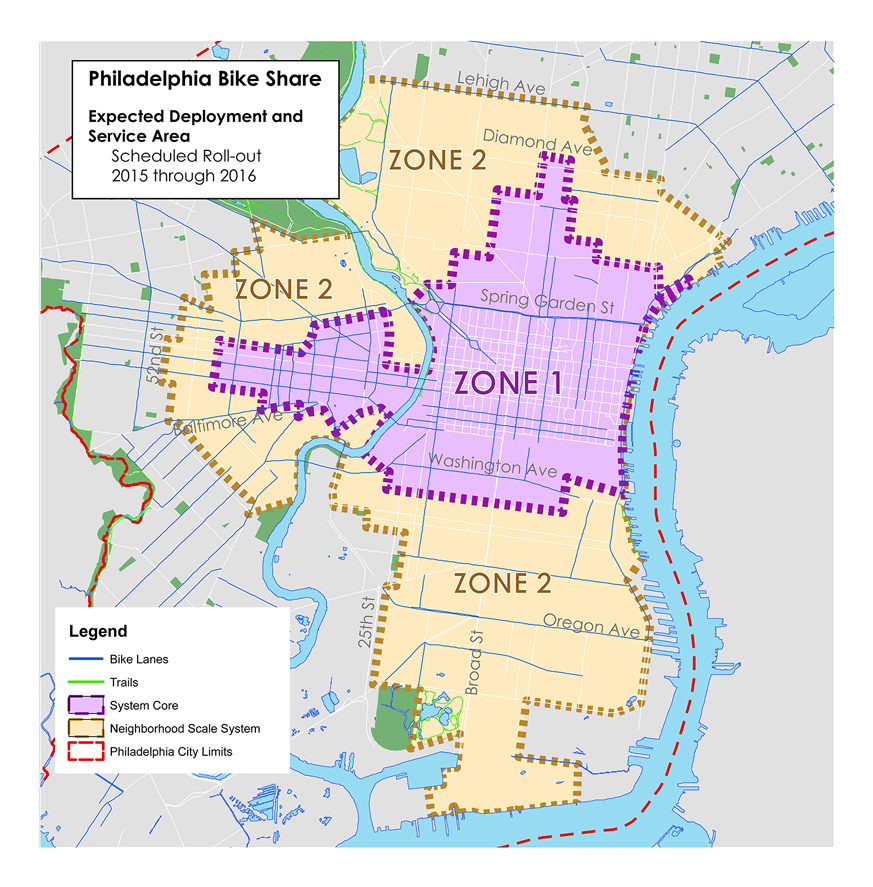
Philadelphia’s bikeshare map: the new hotness.
While the litany of despair form the schools is rightly demoralizing, I take great hope from the ambitious geographic scope laid out for the 2014-15 rollout of the city’s new bikeshare program, whose map I include above. Bikeshare is by far the cheapest and most cost-effective investment available in mobility today, and can pull a lot of pressure off of crowded buses in Greater Center City. The decision to spread the system all the way north to Lehigh Ave by 2015, an ambitious service territory for a fledgling system, serves two purposes. It makes the system available to current residents of neighborhoods beyond Greater Center City, who are, if anything, even more in need of bikeshare as inexpensive transit. And it lays out a marker for newcomers and the developers who want to build for them, saying “we’re going to do whatever we can to expand the desirable area of this city to be as inclusive, geographically and demographically, as we can”. In a city that’s still, in many ways, struggling for its own soul, that’s a big commitment. We’ll see if, and how, it sticks.


 Sic Transit Philadelphia